🍦 Frozen Yogurt Is Becoming a Night Out Again

Froyo is back—but this time the interesting part isn't what's in the cup. It's what is happening around it.
```At some point, frozen yogurt stopped being merely dessert and started becoming plans.
Not:
“Do you want frozen yogurt?”
But:
“Where should we go tonight?”
“Froyo?”
And that tiny linguistic shift may explain more about the frozen yogurt comeback of 2026 than another discussion about probiotics ever could.
Because the new froyo boom isn't simply about bringing back a 2010s dessert.
It's about turning the frozen yogurt shop into something surprisingly valuable in modern hospitality:
a place to go.
A casual date. A post-dinner stop. A place to meet friends. Somewhere to sit at 9:30 p.m. when nobody particularly wants another cocktail, nobody wants to go home yet, and everybody is somehow willing to debate pistachio cream versus cookie crumbs for fifteen minutes.
Frozen yogurt has been here before.
But it has returned wearing much better lighting.
People aren't just talking about froyo. They're showing up.
Placer.ai reported that visits to frozen-yogurt chains were up year over year during nearly every week of the first half of 2026, with growth topping 18% during some weeks.
```🌀 Wait. Didn't We Already Do Frozen Yogurt?
Oh, absolutely.
If you lived through the late 2000s and early 2010s, you may remember a time when frozen yogurt stores appeared to reproduce overnight.
One day your neighborhood had a dry cleaner.
The next day it had six yogurt machines, lime-green chairs and seventeen containers of crushed Oreos.
The original boom was built around a compelling formula: self-service, endless toppings, customization and a better-for-you halo.
Then came oversaturation, changing tastes and the unfortunate realization that filling a bucket with frozen yogurt, brownie chunks, gummy worms, caramel and cheesecake pieces did not necessarily become a health food simply because the container was weighed at the register.
By the mid-2010s, the frenzy cooled.
But trends rarely return in exactly the same clothes.
The 2026 version of froyo is being discussed as a genuine renaissance, with new shops drawing lines, renewed social-media attention and brands repositioning yogurt around premium ingredients, protein, probiotics and experience rather than the old low-fat diet language.
Same swirl.
Entirely different personality.
🌙 The Most Interesting Part: Froyo Is Becoming an Evening Activity
This is where the story gets much more interesting for restaurants.
A successful dessert business doesn't necessarily compete with another dessert business.
It competes for occasions.
Friday-night drinks are an occasion.
Coffee with a friend is an occasion.
Date night is an occasion.
The after-dinner walk where everyone says, “We could get something sweet…” is also an occasion.
The newer generation of frozen-yogurt businesses seems to understand this very well.
Yo-Chi, one of the brands closely associated with the current froyo excitement, doesn't merely describe its product. Its own brand language repeatedly emphasizes venues, hanging out and creating your own experience. Some Australian locations stay open until 10 or 11 p.m.—hours that look much more like casual nightlife than a conventional daytime snack shop.
That matters.
Because the business isn't only selling frozen yogurt anymore.
It is selling the answer to:
```“What should we do after dinner?”
```🛋️ Froyo Has Accidentally Become a Third Space
Hospitality people talk a lot about the idea of the third space: somewhere that isn't home and isn't work where people can simply exist together.
Traditionally that might have been a pub, diner, café or neighborhood bar.
But today's social life is creating room for new versions.
Frozen-yogurt shops have several surprisingly useful characteristics:
That final point is particularly important.
Younger adults have become less likely to drink alcohol than in previous decades. Gallup reported in 2025 that only half of U.S. adults ages 18–34 said they drink, down from 59% in 2023.
That doesn't mean nightlife is disappearing.
It means the definition of nightlife can expand.
A night out can be cocktails.
Or tacos.
Or a movie.
Or standing in front of eighteen toppings while your friend asks whether adding olive oil to Greek frozen yogurt is sophisticated or evidence that everyone has finally lost control.
🎨 The Product Is Also the Entertainment
Here is another reason froyo works unusually well as an experience:
The customer gets something to do.
Choose a cup.
Pull a handle.
Mix flavors that perhaps should never have met.
Walk slowly past toppings.
Change your mind.
Add strawberries for health.
Add cookie butter because health has now concluded.
Photograph the result.
Compare everybody's bowl.
It's a tiny activity disguised as dessert.
A cocktail bar gives you a drink.
Froyo gives you a minor creative project with sprinkles.
From an experiential-retail perspective, that's powerful.
Customization gives customers a sense of ownership while creating endless visual variation for social media.
Yo-Chi literally frames its yogurt as a “canvas,” while brands such as 16 Handles continue to emphasize rotating flavors, customization and novelty products.
✨ The Topping Bar Grew Up
The old froyo topping bar had a very specific energy.
Gummy worms.
Rainbow sprinkles.
Brownie cubes.
Chocolate chips.
Mysterious red spheres nobody could confidently identify.
Those aren't gone.
But the new froyo vocabulary has become noticeably more premium.
Current shops and trend coverage are highlighting ingredients such as pistachio cream, artisan honey, olive oil, fresh fruit, compotes and more sophisticated flavor combinations.
Suddenly the topping bar looks less like a children's birthday party and more like the pantry of someone with very strong opinions about sea salt.
🍨 The New Luxury-Froyo Vocabulary
```Pistachio cream • tahini • honeycomb • berry compote • olive oil • flaky sea salt • fresh mango • roasted nuts • granola clusters • matcha • dark chocolate • seasonal fruit
```The strategic benefit is obvious.
Premium toppings raise the perceived value of a product that still feels approachable and playful.
You aren't ordering a plated $18 dessert with three words of description and an unidentified foam.
You are making your own bowl.
But now it happens to contain Sicilian pistachio cream.
💪 Froyo Has Also Learned the Language of 2026 Wellness
The original frozen-yogurt boom often spoke the language of subtraction.
Low fat.
Fewer calories.
Dessert, but somehow apologizing for itself.
The new wave speaks much more in the language of addition.
Protein.
Probiotics.
Live cultures.
Real milk.
Fresh fruit.
Plant-based options.
That shift is showing up across the current category: Vox has described the comeback as tied to protein, digestive-health and wellness culture, while major operators advertise probiotic, kefir, plant-based and high-protein formats.
Of course, a cup piled with cookie butter and chocolate remains dessert regardless of how many live cultures attended the meeting.
But from a branding perspective, the repositioning matters.
Modern consumers don't necessarily want indulgence replaced by wellness.
They often want both in the same cup.
🧠 The Restaurant Lesson: Don't Sell the Product. Sell the Occasion.
This may be the most useful takeaway from the frozen-yogurt comeback for the broader hospitality business.
Restaurants often spend enormous amounts of energy improving products:
Better ingredients.
New flavors.
Different presentation.
More elaborate menus.
Another sauce with an ampersand somewhere in the description.
But sometimes the larger opportunity is not improving what people buy.
It's changing when and why they buy it.
Frozen yogurt becomes much more valuable when it moves from:
“I want dessert.”
“I want somewhere fun to go with my friends tonight.”
The second customer is not merely purchasing yogurt.
They're purchasing time.
🪩 This Is Why Store Design Suddenly Matters So Much
If your business wants customers to treat dessert as a night out, the dining room cannot feel like a place designed exclusively for consuming 240 grams of dairy and immediately leaving.
The new frozen-yogurt shop increasingly borrows cues from cafés, lifestyle stores and casual hospitality.
Think:
💡 warm, flattering lighting
🪑 comfortable seating
🌿 thoughtful interiors
🎵 music that encourages lingering
📸 highly photographable counters and products
🌙 late opening hours
✨ enough visual identity that the room itself becomes part of the outing
Yo-Chi explicitly encourages customers to “hang out” in its spaces, while 16 Handles promotes modern store design as part of its current franchise proposition.
That's hospitality strategy hiding inside interior design.
🍽️ And Yes, Even Froyo Is Growing Up Into Tableware
The classic frozen-yogurt vessel is functional:
paper cup.
plastic spoon.
slightly questionable architectural integrity once the toppings reach the rim.
But there is an interesting opportunity for dine-in concepts to make frozen yogurt feel even more like a restaurant occasion.
Imagine premium froyo served in:
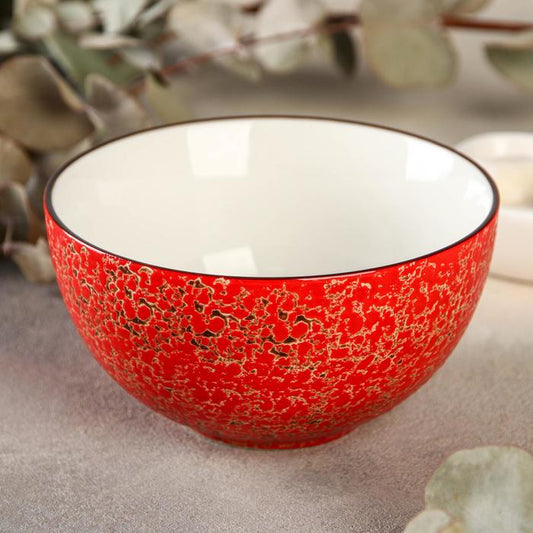
🤍 low white porcelain bowls
🏺 handmade-look stoneware
🌸 soft blush ceramics
🥄 polished dessert spoons
🍓 individual topping dishes for premium combinations
A swirl of tart yogurt with pistachio cream, strawberries, honey and sea salt suddenly doesn't look like a snack.
It looks like plated dessert.
The ingredient cost may not have changed dramatically.
The perceived occasion certainly has.
💕 Frozen Yogurt May Be Weirdly Perfect Date-Night Food
Consider the logistics.
It is casual enough for a first date.
Affordable enough that ordering doesn't require a brief discussion about macroeconomic conditions.
Customizable enough that two people don't need to want the same thing.
And because you're walking around constructing the bowl, there is an activity built into the interaction.
You immediately learn things about a person.
For example:
Do they mix chocolate and mango?
Do they build topping layers?
Do they put gummy bears on Greek yogurt?
Are you prepared to construct a life with someone capable of these decisions?
Frozen yogurt asks the important questions early.
👯 It Also Solves the “Mixed Group” Problem
Groups are difficult.
One person wants dessert.
One wants something “healthy.”
One is dairy-free.
One wants chocolate.
One says, “I don't really want anything,” before eating half of everybody else's food.
Customizable froyo handles these groups unusually well.
Modern operators now offer combinations of dairy, plant-based, tart, sweet, high-protein and fruit-forward products, allowing one venue to satisfy very different dessert expectations.
That flexibility is commercially useful because it widens the veto window.
In restaurant terms, the person saying “there's nothing for me” can kill a group visit.
Froyo says:
Fine. Build your own.
📱 Why Froyo Was Basically Engineered for TikTok
Frozen yogurt existed before TikTok.
But frozen yogurt understands TikTok.
Consider the content:
🎥 the swirl
🍓 the topping pour
⚖️ the weigh-in
😳 the price reveal
🥄 the first bite
✨ the finished bowl
The entire purchasing journey can become a 15-second video without anyone needing to invent a concept.
Social media has been repeatedly identified as one of the forces behind the current revival, with viral queues and highly personalized bowls helping push froyo back into cultural conversation.
The product generates its own before-and-after sequence.
Marketing departments everywhere quietly weep with envy.
💰 Why the Format Is So Interesting From a Business Perspective
Frozen yogurt combines several things hospitality operators usually struggle to achieve simultaneously.
| Customer Benefit | Business Benefit |
|---|---|
| Customization 🎨 | More combinations, repeat visits and social content |
| Self-service 🍦 | Customer participates in product assembly |
| Premium toppings ✨ | Higher perceived value |
| Late-night appeal 🌙 | Access to post-dinner traffic |
| Group-friendly 👯 | Broad appeal across preferences |
| Social experience 📱 | Organic word-of-mouth and user-generated content |
And the renewed customer interest is translating into expansion activity. 16 Handles is currently marketing new franchise growth around a modernized product mix that includes high-protein, kefir, oat-milk and limited-edition flavors.
👨🍳 Five Things Restaurants Can Learn From Froyo's Comeback
Interactive food creates memory. A topping station, tableside finish or customizable dessert can turn ordering into part of the entertainment.
Want evening traffic? Lighting, music, seating and hours need to say “stay,” not “consume product and kindly disappear.”
Pistachio cream can sit next to sprinkles. Restaurants don't always have to choose between sophisticated and fun.
Customers still want to socialize even when they aren't drinking. Dessert can become an evening destination instead of an afterthought.
People can eat yogurt at home. The business opportunity is giving them a reason to leave home to do it together.
🌃 Picture the New Froyo Night Out
It's 9:20 p.m.
Dinner is finished.
Nobody wants another drink.
Nobody wants the evening to end.
``` You walk into a bright, beautifully designed yogurt shop.
Music is playing.
Groups are sitting around small tables.
Someone is filming a pistachio drizzle.
Someone else has created a bowl weighing approximately the same as a small house cat.
You order.
You sit.
You talk for another hour.
That's not really a frozen-yogurt transaction.
That's hospitality.
🔮 The Bigger Trend Isn't Froyo. It's Casual Experience.
Frozen yogurt may eventually cool off again.
Food trends always do.
But the customer behavior underneath this comeback is much more interesting.
People still want small reasons to go out.
They want environments that feel social without requiring a major commitment.
They want food that is customizable, photographable and just indulgent enough to feel like a treat.
They want places where one person can be wellness-minded, another can order chocolate, another can skip alcohol and everybody can still share the same experience.
That is why the most useful question isn't:
“Why is frozen yogurt back?”
```It's:
“What kind of night out are people looking for now?”
```🍦 Final Swirl: Frozen Yogurt Isn't Just Back. It Has Somewhere to Be.
The froyo revival could easily have been pure nostalgia.
Bring back the machines.
Bring back the toppings.
Let everyone briefly pretend it's 2011.
But something more interesting happened.
Frozen yogurt found a new job.
It became a low-pressure date.
A post-dinner destination.
A customizable little luxury.
A social-media object.
A place teenagers, adults, families, couples and friends can all plausibly suggest without triggering a 47-message group-chat negotiation.
That's why this story matters beyond dessert.
The smartest hospitality businesses don't merely ask what customers want to eat.
They ask what customers want an excuse to do.
Right now, apparently, one answer is:
Go out. Stay awhile. Get something sweet.
```And yes, add the pistachio cream. 🍦✨🌙
```